Inside a Tender
Two returns from five
Co-founder, practising building surveyor
For four weeks the Hartwell House tender gave me no trouble at all. Five contractors had said yes, nobody raised a query, and there was nothing to chase. That is also exactly what a tender looks like when three of them have silently decided not to price it.
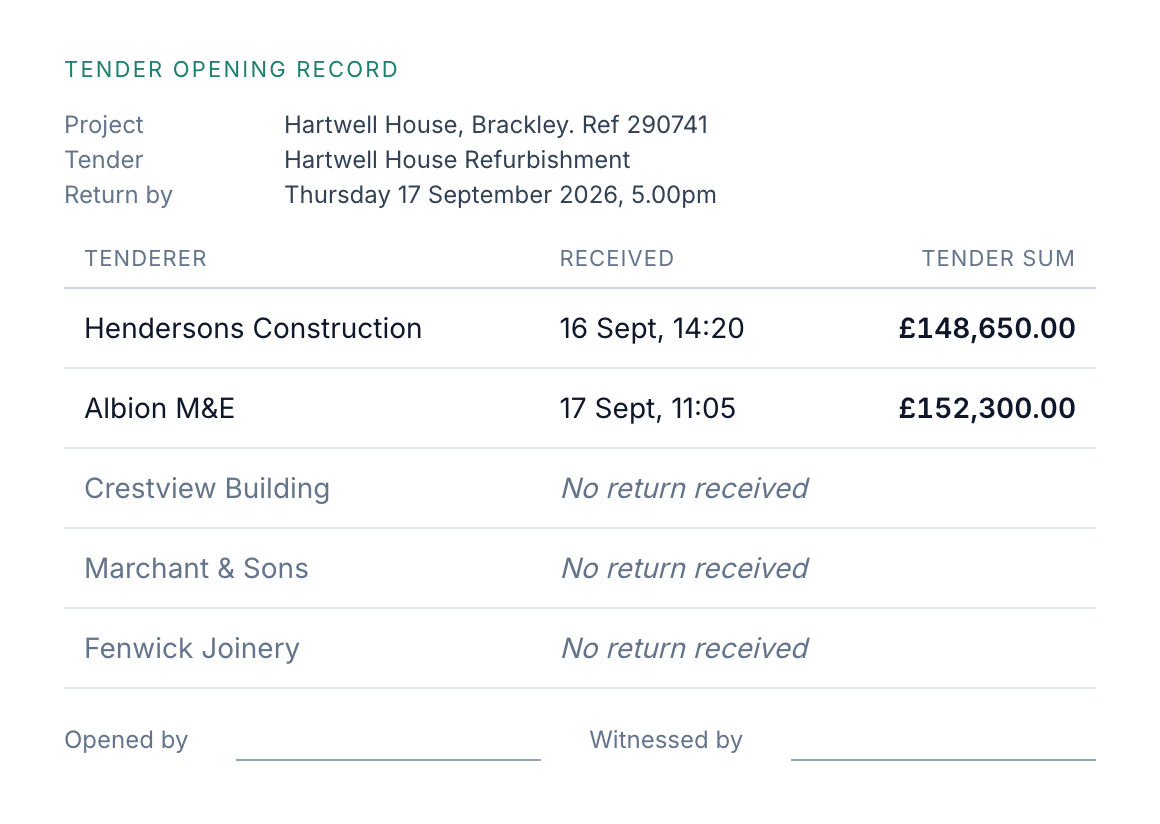
On the Thursday it was due back there were two returns in my inbox, Hendersons and Albion, and nothing from the other three. Not a withdrawal, not an apology, nothing. By mid-afternoon the client was on the phone asking, reasonably, what had happened to the month.
Note: This Hartwell House project is a composite and the firms are invented, as they always are here. The morning, however, is not. Most surveyors who run small works tenders have had one like it. What went wrong did not go wrong on return day.
Two duties, pulling in seemingly opposite directions
When levelling tenders, the RICS Rules of Conduct ask two things of me that seemlingly pull against each other. Rule 3 asks for a good-quality, diligent service. The client engaged us to run a competition. Rule 1 asks for honesty and integrity, and its example behaviours include not being improperly influenced and staying alert to conflicts of interest. In practice that means every tenderer gets the same treatment, and I have to be able to show it.
Chasing is where the two meet. Ring one contractor to ask whether their return is coming and you have given them something the others did not get: a reminder, a hint that the field is thin, a chance to ask a question in passing. Nobody wants to be seen to favour a contractor. The client doesn't want the project to slip a month either, and if nobody chases and the tender collapses, "I did not want to be seen to favour anyone" is not an answer they will accept.
What the guidance actually says
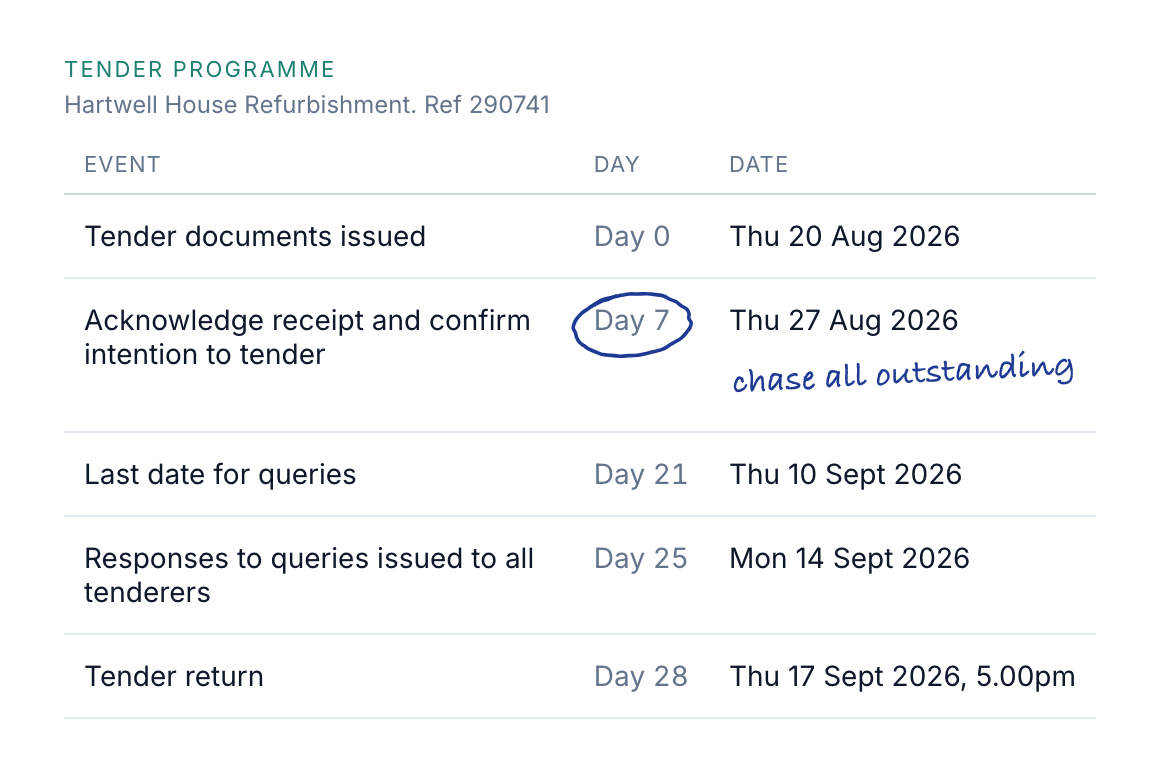
The JCT practice note on tendering starts before the pack. It expects a preliminary enquiry: a short letter asking whether the contractor is willing and able to tender, and asking them to say promptly if that later changes. It treats three to six tenderers as the normal field. Its rule for everything after that is equal treatment. Clarifications go to every tenderer at the same time. Late returns are not considered. If the invitation reserved the right to extend, the period can be extended, and that too goes to everyone.
The RICS guidance note on tendering strategies gets closer to the awkward part. It allows for contact during the tender period, in the form of a mid-tender interview: a chance to review progress and for the tenderer to reaffirm their commitment. The condition is that anything disclosed in that conversation is formalised and issued to all tenderers as a query response or an addendum. Contact mid-tender is legitimate, then, provided it cannot leave one tenderer knowing something the others do not.
Taken together, the two documents don't say "never chase". They say the chase must be the same for everyone, and anything it produces must reach everyone.
How we do it
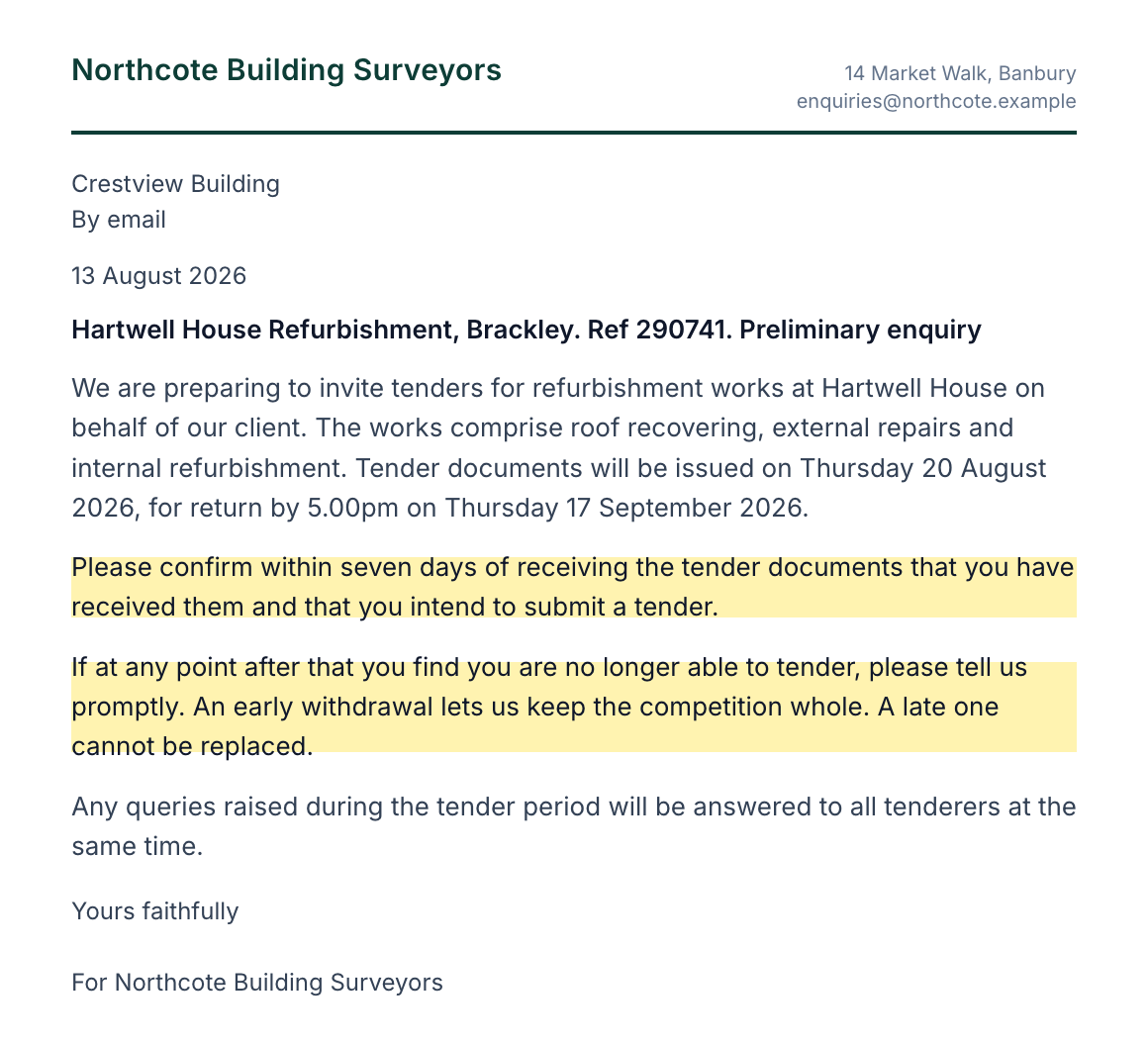
The practice below came out of mornings like that one. Often, the pack goes out with a request: confirm within seven days that you have received it and that you intend to tender. On day seven, anyone who has not confirmed gets a chase. Everyone who has not confirmed, on the same day, with the same wording. Once a contractor has confirmed, we leave them alone until the return date.
This is the important bit: the chase is addressed to a state rather than to anybody in particular, and whoever is in that state gets it. Nobody can say we chased Hendersons and not Crestview, because it was the rule that decided who was chased, not me. The touch lands at the same moment for everyone in the same position, and the file shows it. And a firm that confirms has told us, in writing, that they are in. If they later go quiet, they have broken a commitment, which is much easier to act on than an ambiguity.
Some confirm and then submit nothing anyway. The practice does not fix that, and I would not trust one that claimed to. What it does is tell me early which firms were never going to tender at all.
Why contractors can go quiet
The RICS note gives two typical reasons a tenderer withdraws, and I've experienced both. The first is that work has picked up since they said yes and the resources are no longer there. Spring is the reliable season for this. Every surveyor with external works to price sends the pack out in April for a summer start, and every contractor with a scaffold and a roofer is booked through to September by the time the return date comes round. They meant it when they confirmed, but the diary changed.
The second is that, having read the pack properly, they do not think they will be competitive, or they think the job carries more risk than the margin is worth.
A contractor opens the schedule, sees the access constraints or the scale of the thing, does a rough sum, and then decides not to price it. They go quiet. Very few will write to say so, partly because it feels like admitting something and partly because silence costs them nothing. The issue is that their silence costs me time, and leaves the tender uncertain.
Neither reason is a criticism of the contractor. Both are ordinary. The trouble is when I hear about them: on deadline day.
The value of knowing early
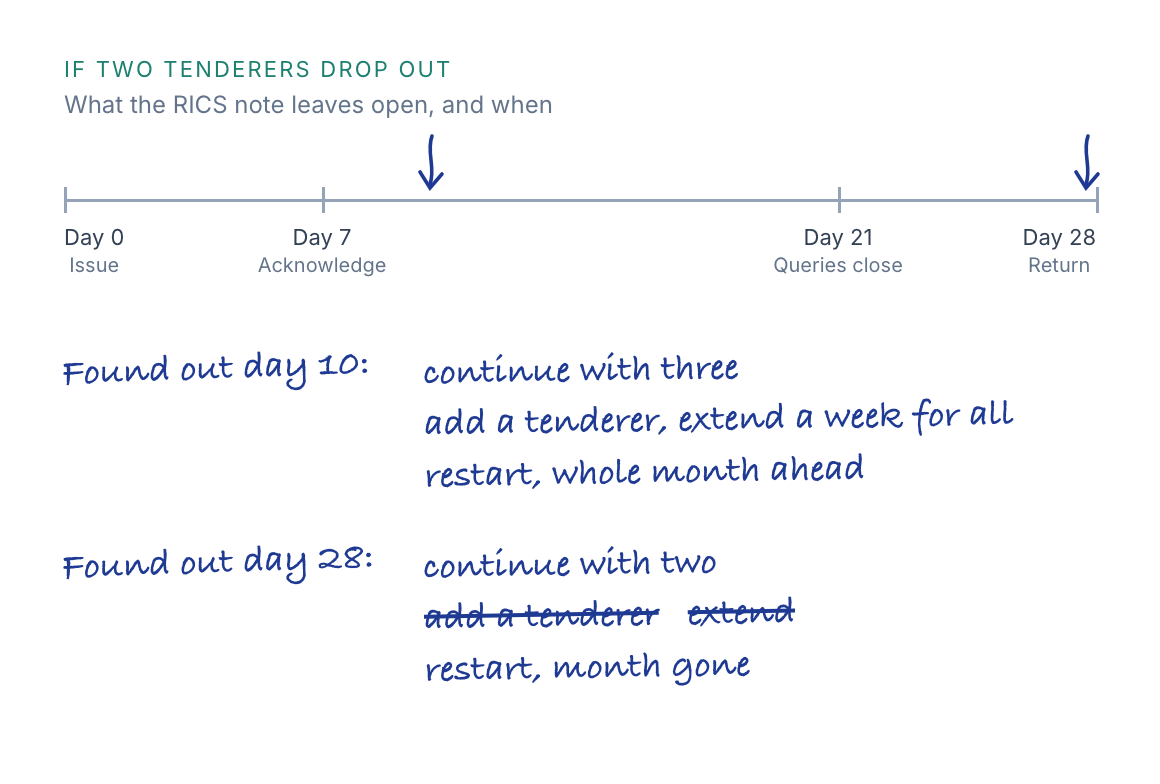
When more than one tenderer drops out, the RICS note gives three options: continue with the remaining tenderers, add a tenderer if the client's procurement process allows it, or cancel and start again. In each case every tenderer is notified, and where the period is extended, everyone gets the extension.
Put those three against a calendar and something becomes quite obvious. Every one of them is worth a great deal on day ten and almost nothing on day twenty-eight.
On day ten, adding a tenderer is a simple invitation and a courtesy extension of a week. The new firm gets a fair run at the pack, and the client hears "we have lost two, we have added one, the date moves by a week" while that is still a plan rather than an apology. Continuing with three is a real choice rather than a default. Restarting is expensive, but the client can decide it with the full month still in front of them.
On day twenty-eight, adding a tenderer means asking two firms who have already priced to wait a fortnight while a third catches up, which is unfair to them and looks a lot like the favouritism the guidance warns against. Extending is only available if the invitation reserved the right, and it extends nothing for the firms who have already gone quiet. Restarting means the month is gone and another is about to be spent. Generally, it is a lose-lose situation.
So the practice has less to do with how hard to chase than with finding out early, the same way for everyone, so that the options are still worth something when I need them.
Deadline day with only two returns
Here is how it goes on the day, with two returns on the desk and three silences.
First, are the two returns a comparison? Yes. Two priced schedules against the same document can be levelled. Are they a competition? Barely. Two firms who both know the field was five have not felt the pressure five would have applied, and the client has paid for a month of that pressure.
Then the programme. The client wanted a start on site in the autumn. Another tender cycle means a winter or spring start, and for external works a season later is a different job. So restarting would cost the client a season.
Then the options, in the order the guidance leaves them. Extend for everyone: possible, because our invitation reserved the right, but an extension does not conjure a return from a firm that has decided not to price, and the two firms who did return are entitled to ask why they are waiting. Add a tenderer: possible if the client's process allows it, with every tenderer told and the date moved for all of them, and we have already seen what that costs on day twenty-eight. Otherwise, restart, and lose the season.
I put that to the client plainly. The choice is theirs. The recommendation is mine, and on this morning it is to level the two, report honestly on how thin the competition was, and let the client decide whether the price they can see is worth more to them than the price they might get in the spring.
The same morning, done differently
Replay the morning with the practice in place. The withdrawals show up in week two, not on return day. The client hears while there is still time to add a tenderer or move the date, and makes the call. Two returns from five is then a result the client chose, not one that landed on them.
Late returns are not considered, whatever the reason, and that rule still holds. What to do with the two that did arrive is still a judgement, and still mine to make. The difference is that I make it knowing what I am looking at.
Oliver Wingfield is a practising building surveyor and co-founder of Tendermark.
Notes
- RICS, Rules of Conduct, October 2021: Rule 1 (honesty and integrity, including the example behaviours on not being improperly influenced and on identifying conflicts of interest) and Rule 3 (good-quality and diligent service).
- RICS, Tendering strategies, 1st edition, guidance note, effective 1 January 2015: section 3.9.3 on mid-tender interviews, section 3.9.4 on tender withdrawals, and section 3.10.1 on returns received after the due date and time.
- JCT, Tendering Practice Note 2017: the preliminary enquiry and model enquiry letter, equal treatment of tenderers, clarifications issued to all tenderers at the same time, three to six tenderers as the norm, extension of the tender period where the invitation reserves the right, and late tenders not being considered.
A monthly note from Tendermark. What we're building, and what we're learning about tender comparison. One email a month. Unsubscribe any time.
We'll only use your email for this. Unsubscribe any time. See our Privacy Policy.